

Skip to content
Law Society of Scotland
Search
Find a Solicitor
Contact us
About us
Sign in
Search
Find a Solicitor
Contact us
About us
Sign in
  • For members

    • For members

    • CPD & Training

    • Membership and fees

    • Rules and guidance

    • Regulation and compliance

    • Journal

    • Business support

    • Career growth

    • Member benefits

    • Professional support

    • Lawscot Wellbeing

    • Lawscot Sustainability

    • Lawscot Tech

  • News and events

    • News and events

    • Law Society news

    • Blogs & opinions

    • CPD & Training

    • Events

  • Qualifying and education

    • Qualifying and education

    • Qualifying as a Scottish solicitor

    • Career support and advice

    • Our work with schools

    • Funding your education

    • Social mobility

  • Research and policy

    • Research and policy

    • Research

    • Influencing the law and policy

    • Equality and diversity

    • Our international work

    • Legal Services Review

    • Meet the Policy team

  • For the public

    • For the public

    • What solicitors can do for you

    • Making a complaint

    • Client protection

    • Find a Solicitor

    • Frequently asked questions

    • Your Scottish solicitor

  • About us

    • About us

    • Contact us

    • Who we are

    • Our strategy, reports and plans

    • Help and advice

    • Our standards

    • Work with us

    • Equality and diversity

Journal logo
  • PRACTICE

    PRACTICE

    • Practice

    • Corporate law

    • Criminal law

    • Employment law

    • Environment law

    • Family law

    • Industry updates

    • Intellectual property

    • Property law

    • Technology law

    • Technology and innovation

    • Practice

    • Corporate law

    • Criminal law

    • Employment law

    • Environment law

    • Family law

    • Industry updates

    • Intellectual property

    • Property law

    • Technology law

    • Technology and innovation

  • PEOPLE

    PEOPLE

    • People

    • Equality, diversity & inclusion

    • Ethics & professional responsibility

    • Obituaries

    • Wellbeing & support

    • Noticeboard

    • From the President's desk

    • People

    • Equality, diversity & inclusion

    • Ethics & professional responsibility

    • Obituaries

    • Wellbeing & support

    • Noticeboard

    • From the President's desk

  • CAREERS

    CAREERS

    • Careers

    • Job board

    • Leadership

    • Management

    • Skills

    • Training & education

    • Careers

    • Job board

    • Leadership

    • Management

    • Skills

    • Training & education

  • KNOWLEDGE BANK

    KNOWLEDGE BANK

    • Knowledge Bank

    • Book club

    • Interviews

    • Sponsored content

    • Next generation

    • Next generation

    • Next generation

    • Space — Scotland's Next Legal Frontier

    • Knowledge Bank

    • Book club

    • Interviews

    • Sponsored content

    • Next generation

    • Next generation

    • Next generation

    • Space — Scotland's Next Legal Frontier

  • ABOUT THE JOURNAL

    ABOUT THE JOURNAL

    • About the Journal

    • Contact us

    • Journal Editorial Advisory Board

    • Newsletter sign-up

    • About the Journal

    • Contact us

    • Journal Editorial Advisory Board

    • Newsletter sign-up

How the Supreme Court will replace retiring Scot Lord Hodge

8th April 2025 Written by: Joshua King

Lord Hodge is retiring from the Supreme Court later this year and as a result the search is on for a replacement - for a new Justice and new Deputy President, writes Joshua King.

But how is a person chosen for one of the most senior judicial posts in the country?

A spokesperson for the Supreme Court said: "The Lord Chancellor has convened selection commissions who are looking for candidates who can show an ability to contribute to the collegiate decision-making of the Court, a sensitivity to the needs of different communities and groups and an ability and willingness to engage in the wider representational and leadership role of a Justice, together with an appreciation of the developing nature of the constitution and law in England, Scotland, Northern Ireland and Wales."

Let's explore the process by which a Justice and Deputy President are chosen.

Who is Lord Hodge

Firstly, a word on the outgoing Deputy President, Patrick Stewart Hodge, Lord Hodge. Born in Scotland and educated at Croftinloan School and Trinity College, Glenalmond (both in Perthshire) as a child, the future Deputy President studied at Corpus Christi College, Cambridge and completed an LLB at the University of Edinburgh. He worked first as a civil servant at the Scottish office, before being admitted to the Faculty of Advocates in 1983. His career in brief:

  • Appointed Queen's Counsel in 1996 (specialised in commercial law property law and judicial review)
  • Part-time Law Commissioner at Scottish Law Commission 1997-2003
  • Judge of the Courts of Appeal of Jersey and Guernsey 2000-2005
  • Procurator to the General Assembly of the Church of Scotland 2000-2005
  • Appointed Senator of the College of Justice 2005
  • Appointed Supreme Court Justice 2013
  • Served as one of Scottish Intellectual Property Judges and Judge in the Lands Valuation Appeal Court
  • Appointed Deputy President of the Supreme Court 2020 (succeeding Lord Reed who became President)

Selection process for Justice of the UK Supreme Court
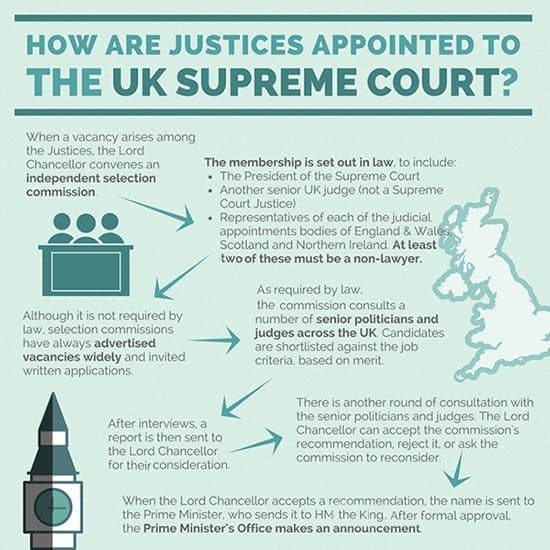
 

Appointment of Justices of the Supreme Court

The process by which Justices are selected is laid out in statute and found in the Constitutional Reform Act 2005 (as amended by the Crime and Courts Act 2013), the landmark legislation which first established the court. Once an independent selection commission is convened by the Lord Chancellor:

  • Lord Chanceller is consulted on position and selection process
  • Vacancy is advertised and candidates can submit personal statements as well as examples of their work
  • The Act requires the Lord Chancellor, the First Minister of Scotland, the First Minister of Wales, the Judicial Appointments Commission in Northern Ireland as well as senior UK judges be consulted
  • Candidates shortlisted and interviewed by the panel
  • The Crime and Courts Act 2013 amended the Act and, as a result, where two candidates are of equal merit, the commission can give preference to one candidate over another for purposes of increasing diversity
  • Following interviews, the Lord Chancellor receives a report and there follows another consultation round
  • The Lord Chancellor can then choose to accept or reject the recommendation, or ask the commission to reconsider
  • Upon acceptance by the Lord Chancellor, both The King and the Prime Minister are informed, the candidate is notified and a formal announcement is made by the Prime Minister's office


How to apply to be a Supreme Court Justice

Potential candidates can contact Grainne Hawkins (grainne.hawkins@supremecourt.uk tel: 020 7960 1906) for further details on the selection process and an application form. The closing date for applications is 5pm 25th April 2025.

The recruitments for Deputy President and for a Justice are running simultaneously. There may be circumstances in which the recruitment for a Justice may be paused to ensure that the Court does not exceed the maximum number of Justices specified in the Constitutional Reform Act.

Watch: What advice would a Supreme Court Justice give to someone with aspirations of joining the judiciary?

Briefing: Tax, a new landscape, Agricultural Property Relief and Business Property Relief
Journal 6th April 2026
Yvonne Evans explores the new rules on Agricultural and Business Property Relief which take effect for deaths on or after 6 April 2026.
The technological lawyer in the age of AI
Journal 1st April 2026
Artificial intelligence (AI) is no longer merely a tool lawyers use. It is becoming an environment in which legal method may be organised, repeated and scaled, says Dr Corsino San Miguel.
Stress, behaviour and boundaries: A new toolkit aims to change how solicitors talk about wellbeing
Journal 1st April 2026
There are some conversations within the legal profession that are widely understood, yet still rarely spoken about openly.
SSDT Decision: Nicola Cannon and a Court of Session appeal
Journal 31st March 2026
An appeal in terms of Section 42ZA(9) of the Solicitors (Scotland) Act 1980 was made by Nicola Cannon against the determination of the Law Society of Scotland.
Read all stories
About the author
Joshua King
Editor of the Journal of the Law Society of Scotland. Leading The Journal's coverage of the legal sector and profession with a clear eye to the future. Qualified in Scots law.
Add To Favorites

Additional

https://lawware.co.uk
https://yourcashier.co.uk/

Related Articles

Widening access to the legal profession in Scotland through Court Brief

27th March 2026
Access to shadowing opportunities can be a major hurdle for law students – especially women, and those from ethnic minority...

Practical PR for Solicitors: How to write thought leadership people actually read and share

12th March 2026
Communications consultant Stewart Argo on how to write thought leadership people actually read and share.

Meet Scotland's 15 new solicitor advocates ready to represent clients in highest courts

25th February 2026
The Law Society of Scotland has granted extended rights of audience to 15 new solicitor advocates across two ceremonies.

Journal issues archive

Find all previous editions of the Journal here.

Issues about Journal issues archive
Law Society of Scotland
Atria One, 144 Morrison Street
Edinburgh
EH3 8EX
If you’re looking for a solicitor, visit FindaSolicitor.scot
T: +44(0) 131 226 7411
E: lawscot@lawscot.org.uk
About us
  • Contact us
  • Who we are
  • Strategy reports plans
  • Help and advice
  • Our standards
  • Work with us
Useful links
  • Find a Solicitor
  • Sign in
  • CPD & Training
  • Rules and guidance
  • Website terms and conditions
Law Society of Scotland | © 2026
Made by Gecko Agency Limited